 Clinical trials operate within a highly regulated framework designed to protect participant safety and ensure data reliability. When Good Clinical Practice (GCP), Standard Operating Procedures (SOPs), or protocol requirements are not followed, deviations, non-compliance, or non-conformance occur and must be properly addressed. ICH GCP requires that significant issues are identified, documented, explained, and managed through Corrective and Preventive Actions (CAPAs).A CLEAR UNDERSTANDING OF CAPA PRINCIPLES IS ESSENTIAL FOR EFFECTIVE QUALITY MANAGEMENT.Applying Corrective and Preventive Actions (CAPAs) is not simply about understanding definitions — it requires sound quality decision-making in complex, real-world situations.This course is designed to strengthen the decision-making capability required to deliver inspection-ready clinical trials. It enables learners to move beyond definitions and templates to critically evaluate issues and implement CAPAs that are Specific, Measurable, Achievable, Relevant, and Time-bound (SMART), with clearly defined roles, responsibilities, and accountability mechanisms that support effective implementation and help prevent recurrence of errors.
- Strengthen Your Trial’s Foundation: Master Data Governance in Clinical Research In clinical trials, participant safety is non-negotiable—but the bedrock of that safety is reliable, well-governed data. According to ICH GCP E6 (R3), both Sponsors and Investigators share equal responsibility for ensuring data integrity across the entire trial lifecycle. Data governance isn't just compliance—it's the foundation for generating credible evidence on the safety and efficacy of treatments. Poor data management risks more than protocol deviations; it jeopardizes trial outcomes, regulatory approvals, and ultimately, patient trust. This course empowers your team to take ownership of data across collection, verification, review, correction, protection, and analysis—ensuring every step is secure, traceable, and compliant. From setting up robust data policies to managing access and oversight, your team will gain practical strategies to uphold the scientific and ethical standards that drive successful trials. Don’t let weak data governance undermine your trial. Enrol your team now and build a culture of data accountability from start to finish.
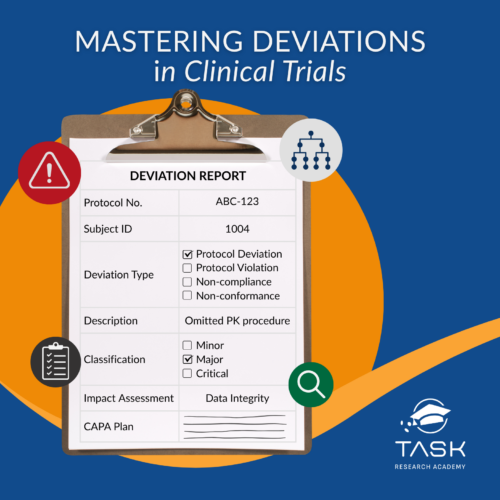
- Turning Quality Events into Quality Improvements Training for Competence, Not Just ComplianceDeviations are an inevitable reality of every clinical trial. However, the way they are recognised, assessed, classified, documented, and managed can determine whether they remain isolated quality events or become opportunities for meaningful quality improvement.Mastering Deviations in Clinical Trials is designed around a simple principle: training should go beyond the certificate.This practical, scenario-based course provides clinical research professionals with the knowledge, skills, and decision-making ability needed to confidently assess and manage protocol deviations and GCP non-compliances throughout the clinical trial lifecycle.Moving beyond simply identifying and recording deviations, the course explores how effective deviation management supports participant safety, data integrity, regulatory compliance, inspection readiness, and the effective management of risk to the trial outcome.Learn Through Real-World ScenariosThis is not simply a course about memorising definitions or learning a process.The course is built around realistic clinical trial scenarios that challenge you to think through a potential deviation as it unfolds. You will be required to assess the situation, consider its potential implications, and make decisions based on the information available to you.Each scenario follows a structured eight-step decision-making process, reflecting the mindset a clinical research professional should apply when assessing a potential deviation:
- Identify which events constitute protocol deviations.
- Assess the potential impact on participant safety.
- Assess the potential impact on data integrity.
- Classify the deviation appropriately.
- Determine where the deviation should be documented.
- Identify the most appropriate next action.
- Consider the regulatory reporting implications.
- Reflect on how an inspector may interpret the case.
- Essential records are the backbone of every clinical trial - the documents that tell the story of how a study was designed, conducted, and validated. They serve as proof of compliance with Good Clinical Practice (GCP) and regulatory requirements, ensuring that data is credible and that the rights and safety of trial participants are protected. Without accurate, complete, and well-maintained essential records, no clinical trial can stand up to scrutiny.Mastering Essential Records, a 2-part series of courses, is designed to give you a clear, practical understanding of the documentation that underpins high-quality research. Whether you in a monitoring role or part of the trial conduct team at site, you will gain the knowledge and confidence to manage essential records with accuracy and purpose.In Part 1 of the Mastering Essential Records Course series, you will learn how to:
- Define what essential records are and recognise which documents are typically classified as essential in clinical trials.
- Understand the vital role these records play in ensuring trial integrity and regulatory compliance.
- Categorise essential records to know when and where each should be filed and updated.
- File and maintain essential records correctly within the Investigator Site File (ISF) and Trial Master File (TMF)
- Essential records are the backbone of every clinical trial - the documents that tell the story of how a study was designed, conducted, and validated. They serve as proof of compliance with Good Clinical Practice (GCP) and regulatory requirements, ensuring that data is credible and that the rights and safety of trial participants are protected. Without accurate, complete, and well-maintained essential records, no clinical trial can stand up to scrutiny.Mastering Essential Records, a 2-part series of courses, is designed to give you a clear, practical understanding of the documentation that underpins high-quality research. Whether you in a monitoring role or part of the trial conduct team at site, you will gain the knowledge and confidence to manage essential records with accuracy and purpose.In Part 2 of the Mastering Essential Records Course series, you will learn how to:
- Define what essential records are and recognise which documents are typically classified as essential in clinical trials
- Conduct and document a comprehensive review of the ISF to verify that essential records are accurate, complete, and audit-ready
- Document and Report on the ISF Review.
- Data integrity around sample management is a team effort, meaning all site staff, CRAs and Lab Personnel involved in sample management, must ensure that their samples are collected, processed, stored, shipped, received and analysed according to standardised principles - Good Clinical Laboratory Practice (GCLP) , Good Clinical Practice (GCP) and processes - outlined in the Study Protocol and Lab Manuals - as well as document all these according to Good Documentation Practices and the ALCOA++ principles.With our immersive and engaging online course in Sample Management, TASK Research Academy will take you on a unique journey, giving you the opportunity to discover, explore and develop competence in sample management and its various stages in a clinical trial, from the pre-analytical stage (preparation, collection to shipment) all the way to its post-analytical stage, as well as performing critical oversight, as conducted in-house as well as by the CRA/monitor. Advocated by years of industry experience and developed by industry subject matter experts, this course will equip you with the knowledge and skills needed for quality sample management in a clinical trial. The course will also introduce you to all the various role players involved and what their responsibilities are toward ensuring the maintenance of sample integrity throughout its lifecycle.The ultimate purpose of a clinical trial is to establish whether a treatment or intervention (such as a drug, vaccine, device, or procedure) is safe and effective in its purpose, for human use. The data, generated from a trial, helps regulatory authorities, healthcare providers, and researchers make evidence-based decisions about whether the intervention should be approved, how it should be used, and what its benefits and risks are. The data is generated from collected samples of participants of the trial. Biological samples are not considered as endpoints in a clinical trial. However, these samples (such as blood, sputum, tissue, or urine) are critical to measuring endpoints, especially in trials that rely on biomarkers, pharmacokinetics (PK), or pharmacodynamics (PD) data. If the samples are used to measure the primary endpoints, it is even more critical that they are handled correctly as failing to meet primary endpoints can make regulatory approval and scientific validation more difficult. As such, the collection, handling, processing, storing, transporting, receipt and analysis of biological samples is key to the integrity of the data generated in a clinical trial.
- The pharmaceutical and clinical research industries tend to work in silos, and staff in support roles are typically only involved in a specific section of the clinical trial life cycle.It's time to break these silos and help staff in support roles see the bigger picture, so that they understand where they fit in the clinical research puzzle, the value of their roles, and how they contribute to participant safety, data integrity, and the overall success of a trial.Having a good overview and broad understanding of the clinical research journey will improve the communication between silos, as well as the confidence, performance, and adaptability of staff in support roles across the clinical trial industry.This course was specifically designed by industry experts, and can be completed in 3 hours. This course does not confer GCP-compliance.




Developing tomorrow’s research
professionals today.
Quick Links:
© Copyright 2026 – Task Academy | All rights reserved.